As an SEO Writer, I stay up-to-date with the latest SEO practices and industry insights to craft content that is search-optimized, credible, and genuinely valuable, designed to perform at its best on SERPs.
Collaborator

AI Mention: How It Works & Tips to Get Your Brand Mentioned

AI ecosystem has grown rapidly and has changed the way customers look for information. More and more potential customers are using AI assistants such as ChatGPT, Gemini, or Claude to find product and solution recommendations, either as an addition to or a replacement for conventional search engines.
This shift has made AI visibility an increasingly important aspect for brands. When your brand is mentioned or recommended in an AI assistant’s answer, that is known as an AI mention. So, how can you get your brand to appear in AI answers? Let’s find out in this article.
What Is an AI Mention?
An AI mention refers to when a brand is named in an answer, summary, or recommendation generated by an AI assistant, such as Google AI Overviews, ChatGPT, Google AI Search, Gemini, Claude, or similar platforms. When your brand appears in an AI answer, it has a chance of making it onto a potential customer’s consideration list.
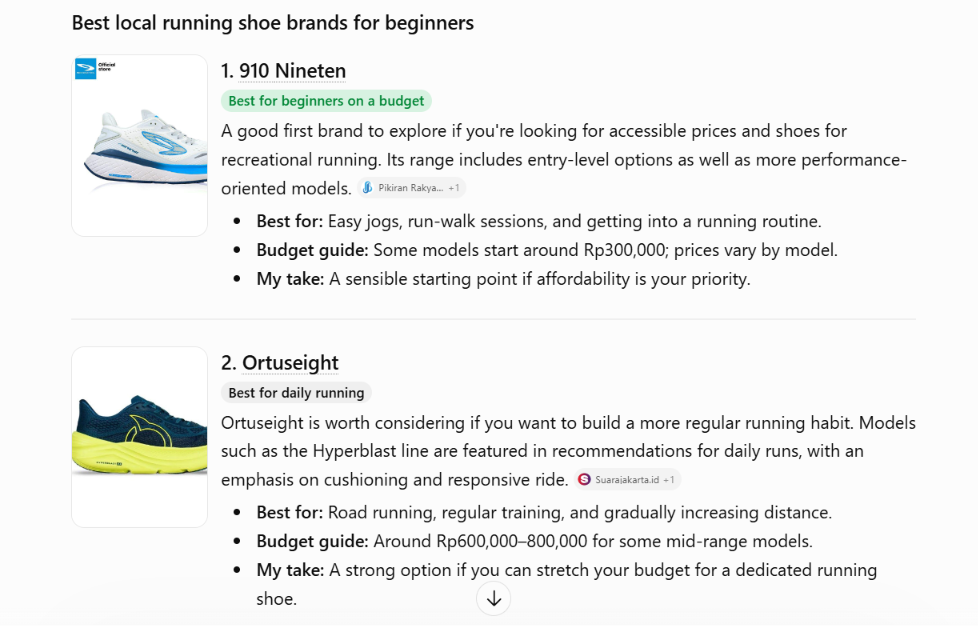
AI mentions can take several forms, for example, in a list of recommendations or product comparisons, within an explanatory paragraph, or in other kinds of responses depending on what the user asks for. In terms of format, an AI mention can also come with a link or be just the brand name without a link (unlinked).
However, in terms of context and tone, a brand mention can be positive, negative, or neutral, so not every AI mention automatically benefits the brand.
AI Mention vs. AI Citation: What’s the Difference?
AI mentions are often treated as the same thing as AI citations, but these two aspects are different. An AI mention focuses on naming the brand, whether in a recommendation list, a comparison, or an example.
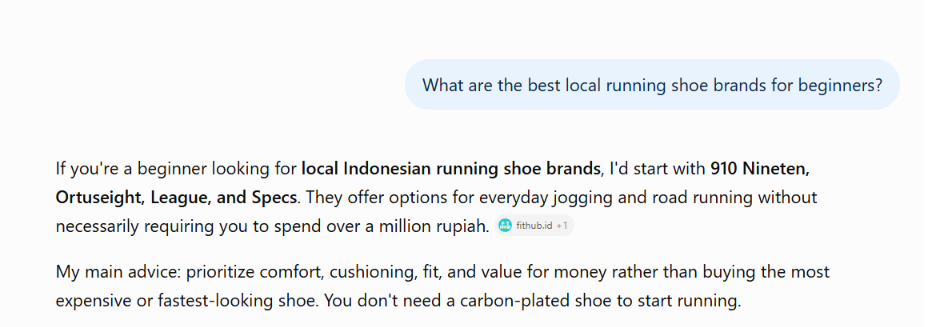
An AI citation, on the other hand, focuses on the source, in which the AI displays a specific page or piece of content from the brand as a reference for the information it provides, usually complete with a link. Here is an example of how it looks:
An example of how an AI mention looks:
An example of how AI citation looks:
Because of this difference, the benefits of the two metrics differ as well. With an AI mention, a brand can make it onto a potential customer’s consideration list. With an AI citation, on the other hand, your content is seen as authoritative and trustworthy as an information source, which can also drive readers to the brand’s website.
In practice, AI mentions and AI citations don’t always appear together. A brand can be mentioned without being used as a source, and vice versa. That’s why brands that want a full presence in AI answers need to pay attention to both.
To better understand how the two differ, take a look at the following aspects:
Aspect | AI Mention | AI Citation |
| What is shown | The brand name within the answer text | The source (page or content) the AI references |
| Link | May or may not be present (linked or unlinked) | Usually comes with a link |
| Visibility | Increases brand awareness | Builds brand authority and brand trust |
| Impact | Recognition of the brand’s existence: owning mindshare, becoming top-of-mind, and entering the consideration list | Reference for information: proof of expertise, potential site visits, and higher trust |
| Optimization | Public relations (PR), organically earned media coverage, third-party mentions, and social media | Creating content worth citing, implementing schema markup, and publishing original research |
| Main trigger | Third-party discussions, reviews, and comparison content | Structured content on your own site that AI can easily extract |
| Example | “cmlabs is a digital marketing and SEO agency” | “As explained in cmlabs’ blog article about GEO [link]” |
Read also: AI Referral Traffic: Definition, Benefits, and How to Measure It
Why Are AI Mentions So Important Now?
Lately, AI mentions have become an increasingly important metric because they can influence potential customers’ purchasing decisions.
A Semrush study found that across 1 million diverse non-branded queries on 5 AI assistants, each AI model included a brand mention in at least 26–39% of its answers.
These mentions have a considerable influence on user decisions, because AI assistants can give personalized answers that feel like a conversation with a human, so users tend to trust them. In fact, at least 94% of potential customers are reported to use AI first before finally committing to a purchase.
That’s why the way your brand is mentioned in AI answers can have a direct impact on user attitudes. If a brand is mentioned positively or neutrally, users are more likely to reach out to your business.
On the other hand, if a brand is mentioned negatively, users’ interest in engaging with it can drop sharply. And if a brand isn’t mentioned in a relevant context, users may never even know it exists.
How Does AI Decide Which Brands to Mention?
Now that we’ve covered the definition of an AI mention, the difference between AI citation and AI mention, and its importance to AI visibility, let's look at how to earn an AI mention.
In short, for an AI to mention your brand, it has to recognize the brand as a distinct entity, find it relevant to the question being asked, and be confident enough to bring it up.
This means that when your brand doesn’t show up for a query relevant to your business, one of the three conditions usually hasn’t been met. Here are some of the factors behind how AI decides which brands to mention:
1. Build a Clear Brand Identity
AI assistants place a high priority on clear brand identity. Positioning that is too generic, such as “business solutions provider,” makes it hard for AI to place your brand in a single category, so it will hesitate to recommend it.
In contrast, when a brand has a clear target market and a specific list of services, AI can match it to users’ questions more easily and recommend it for relevant queries.
2. Make Your Information Easy for AI to Access and Understand
Many AI tools use retrieval-based answers, which means they pull content directly from the web in real time. Google AI Overviews, Perplexity, and ChatGPT with web search all work this way, so your pages need to be easy for AI crawlers to access and filled with consistent, well-structured content.
Read also: What Is llms.txt? Examples, How to Create It, & Its Impact on GEO
3. Build Authority Through Third-Party Signals
A brand that only appears on its own website is hard for AI to trust, since anyone can claim anything. To verify it, AI looks to independent sources like media coverage, competitor comparisons, or descriptions written by others.
Mentions from third parties, especially official institutions, carry extra weight with AI. And when many third-party sources describe your brand in similar terms, AI takes that agreement as a sign the information is reliable.
4. Match What Users Are Actually Asking
AI looks at context, not just keywords. A brand that ranks first for “kids’ shoes” may not get mentioned when a user asks for “kids’ shoes that are good for outdoor use” if the AI has never seen it associated with that use. That’s why a brand that focuses on one specific area is more likely to be recommended than one that tries to be relevant to every need.
5. Keep Your Message Consistent
Publishing more content doesn’t necessarily lead to more mentions. What matters more is keeping the message consistent. When AI finds the same information about a brand across many sources, it becomes more confident about mentioning as its answers
Read also: How to Check Your Website Position on Google and Optimize It
How to Optimize Brand Mention in AI Generative Search
To earn AI mentions, a brand needs to optimize its content for AI search, also called generative search. In digital marketing, this approach is known as Generative Engine Optimization (GEO) and Answer Engine Optimization (AEO).
If traditional SEO focuses on keywords and crawlability, GEO puts more emphasis on content structure, brand authority, and citations. Here are the steps you can take to optimize generative search:
1. Create Content Worth Referencing
AI tends to reference content that offers something new, so publish original data, such as industry research built on your own customer data, or create useful tools like an ROI calculator. Being the source of the data, rather than just citing it, makes your brand more likely to be mentioned.
2. Build Trust Through Recommendations from Multiple Sources
AI has no opinions of its own, so it looks at which brands appear most often in recommendation lists on authoritative sites. Start by auditing the “Best [category]” lists in your industry, then work to get your brand onto them through digital PR or media placements. You can use Media Placement and Backlink service by cmlabs, which is supported by 500+ trusted media domains.
3. Manage Customer Reviews and Sentiment
Customer reviews help AI understand the quality of a product. The more reviews you have, and the newer and more detailed they are about specific features, the more likely your brand is to be mentioned. So don’t leave sentiment analysis out of your GEO or AEO strategy.
4. Structure Your Content So AI Can Easily Cite It
Use question-style headings, then answer them directly and concisely right below. Comparison tables work well too, since AI tends to understand them more easily than long paragraphs of explanation.
5. Strengthen Your Brand Identity in Online Databases
Make sure your brand information is accurate and consistent on third-party platforms such as Wikidata, Wikipedia, and LinkedIn. AI also relies on these pages to confirm that your brand is a real, clearly defined, and trustworthy entity.
6. Back Up Your Content with Data, Quotes, and Brand Context
Specific content is easier for AI to understand and cite. So avoid vague claims like “sales increased,” and replace them with clear numbers, for example “sales grew 14% in the third quarter.”
Quotes from credible experts, written in easy-to-understand wording, also help AI process your content. You can also write your brand name right next to its category or service. For example, “[Brand] is an SEO agency for B2B SaaS companies” ties the brand directly to its category.
7. Show Up Authentically in Communities
AI increasingly values authentic human discussion, such as on Reddit, Quora, industry forums, or LinkedIn. So brands should join in by giving answers that are genuinely helpful, not just promotional.
Read also: GEO & AEO KPIs: How to Measure AI Optimization Metrics
How to Track Your AI Mention Performance
You can monitor AI brand mention performance with AI mention tracking tools. It is a tool that shows how often and in what context your brand is mentioned in AI answers. Some trackers offer a free version or a trial period, though their features are usually limited.
If the data from these trackers is difficult to read, or you’re not sure what to do next, you can try the FREE AI Visibility Audit by cmlabs. This service is 100% free, with the audit results being delivered in just 3–5 business days, and with no contract.
Optimize for AI Mentions with GEO & AEO Services by cmlabs!
cmlabs is an SEO and GEO agency that can help your brand get recommended by AI while staying ranked #1 on Google. Since 2019, cmlabs has been trusted by 100+ businesses and major companies in Indonesia and around the world.
With extensive SEO experience behind it, cmlabs can help brands strengthen their technical SEO foundations to perform better in AI search, including boosting AI mention metrics.
If you want your brand to be easier to find in AI answers, the AI Search Optimization (GEO/AEO) service by cmlabs can help raise your business’s visibility across AI platforms, including ChatGPT, Gemini, Claude, and more.
Every company is different, so we tailor each strategy to your business needs, target audience, and target market to deliver the right results. So talk with our team today to discuss or learn more about our services!

Risca Fadillah
Thank you for taking the time to read my article! At cmlabs, we regularly publish new and insightful articles related to SEO almost every week. So, you'll always get the latest information on the topics you're interested in. If you really enjoy the content on cmlabs, you can subscribe to our email newsletter By subscribing, you'll receive updates directly in your inbox. And hey, if you're interested in becoming a writer at cmlabs, don't worry! You can find more information. here So, come join the cmlabs community and stay updated on the latest SEO developments with us!
Subscribe to Our Newsletter
Enter your email to receive news from us