What Is Answer Engine Optimization (AEO)? A Guide to Optimizing Business
Published at Sep 21, 2026 | Last updated at Sep 25, 2026
Risca Fadillah
Thank you for taking the time to read my article! At cmlabs, we regularly publish new and insightful articles related to SEO almost every week. So, you'll always get the latest information on the topics you're interested in. If you really enjoy the content on cmlabs, you can subscribe toBy subscribing, you'll receive updates directly in your inbox. And hey, if you're interested in becoming a writer at cmlabs, don't worry! You can find more information.So, come join the cmlabs community and stay updated on the latest SEO developments with us!
If you are wondering what Answer Engine Optimization (AEO) is, the short answer is a content optimization strategy designed to get your content selected and directly cited by AI overviews. Recently, AEO optimization strategies have been increasingly adopted by businesses to adapt to changes in user search behavior.
This is because users who were previously accustomed to searching via search engines like Google are now turning to AI for answers more often. For business owners, understanding how AEO works has become a necessity, not just an option.
According to research, more than 60% of Google searches now end without a single click. This indicates that if your business’s content does not appear in the AI Overview, the chances of being discovered by potential customers also decrease.
This article will discuss what AEO is, how it differs from SEO and GEO, and how answer engine optimization works so your business's content can appear in the AI Overview.
Therefore, if you are a business owner, digital marketer, or IT professional, be sure to read this discussion all the way through!
What Is Answer Engine Optimization (AEO)?
AEO stands for Answer Engine Optimization, which is the practice of optimizing content for answer engines so that AI systems can understand and extract relevant information to answer users’ questions.
AEO encompasses marketing practices that increase brand visibility in AI Answer features, including Google AI Mode and ChatGPT.
Does Answer Engine Optimization replace SEO? The answer is no. AEO is not a replacement for SEO. Rather, AEO complements website optimization. While SEO helps search engines find the pages more easily, AEO helps the information on those pages be more easily understood and cited by AI as concise answers to users’ questions.
How Does AEO Work?
Before delving further into AEO strategies, understand how it works. Here are several best-practice steps for Answer Engine Optimization in the AI industry when selecting and displaying answers:
1. Retrieving Content from the Web
AI systems like ChatGPT and Perplexity retrieve the latest content from the web using crawlers such as OAI-SearchBot and Perplexity Bot. This process is called Retrieval-Augmented Generation, which combines data from real-time search results with the model’s training data.
2. Language and Context Understanding
Once the content is retrieved, the system analyzes the intent and context of the user’s question using a technology called natural language processing. This technology enables the AI to recognize entities, relationships between topics, and the meaning behind a question, rather than simply matching relevant keywords in the content.
Next, the AI system selects the information it considers most relevant from available sources to formulate an answer. Therefore, clear content structure, specific information, and answers that directly address the user’s intent can help the AI identify appropriate content segments to use in its response.
Where Does AI Optimization Come Into Play?
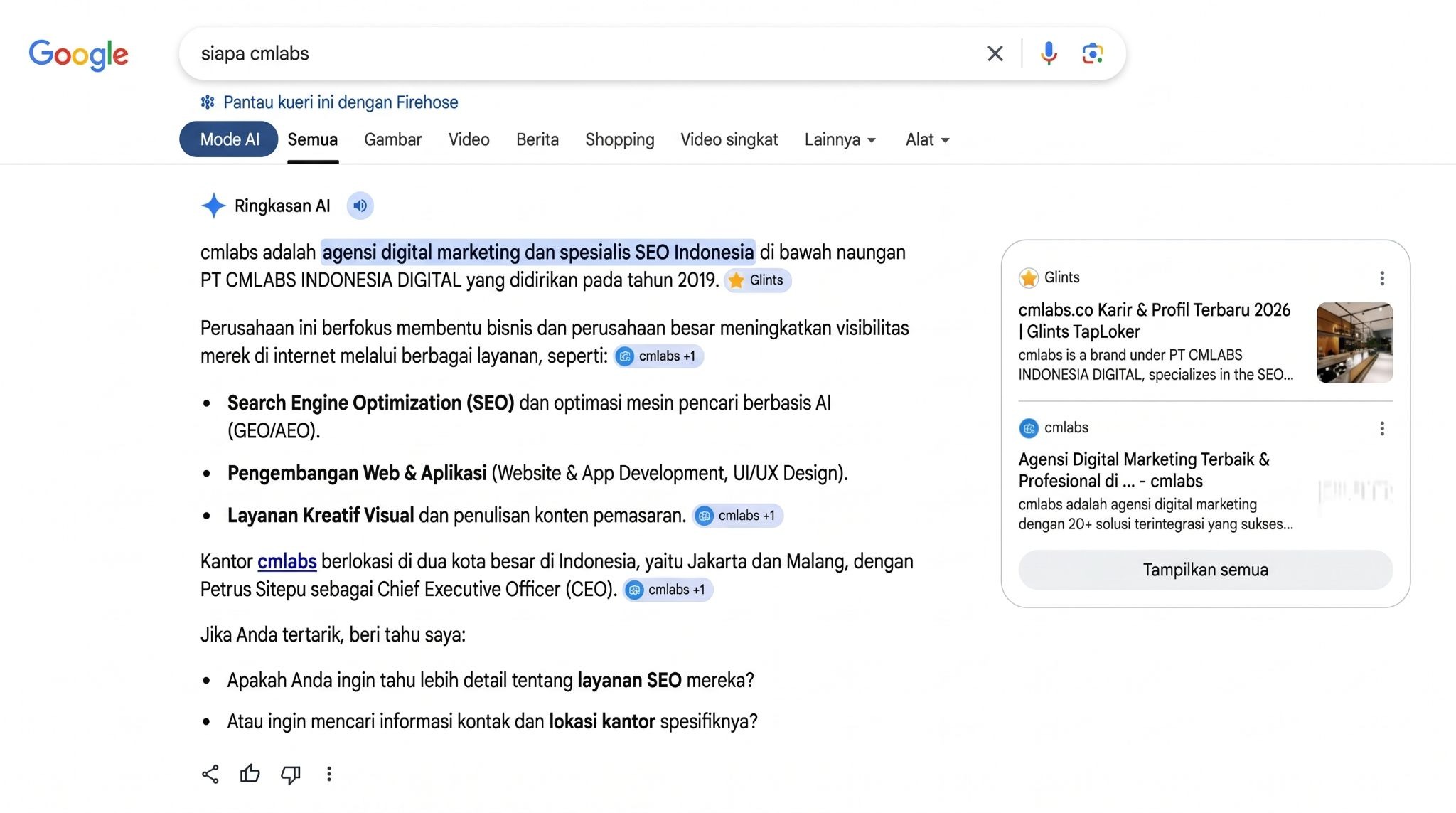
The results of this optimization can be seen on several pages, such as the Google AI Overview, AI Mode, and even in the direct answers provided by ChatGPT and Perplexity. On the Google AI Overview, for example, concise answers are displayed at the very top of the search results page along with the cited sources.
Additionally, these AI optimization results will also appear in features such as featured snippets, “People Also Ask,” and the voice search assistant on Google Assistant. All of these platforms represent new opportunities for your business to position itself as a trusted reference.
Why Does AEO Need to Be Optimized?
AEO is becoming increasingly relevant for businesses because the way users find and evaluate information has changed. In fact, there are several reasons why a business needs to implement this strategy. Here are a few of them:
Zero-click searches continue to rise: As mentioned earlier, 60% of search results now end without a click. This means that if your business relies solely on SERP rankings and is not cited by AI, it risks losing exposure even if it remains on Google’s first page.
Higher conversion rates from AI traffic: According to a study by Semrush, visitors coming from AI search have a conversion rate 4.4 times higher than visitors from organic search. This means that even though the traffic volume may not be large, the likelihood of visitors from AI signing up or filling out a form is considered much higher.
Shift in information-seeking behavior: ChatGPT processes billions of prompts every day, and some of its users are professionals looking for business solutions.
A drop in traffic does not necessarily mean a drop in revenue: As long as your brand continues to be cited by AI as a trusted source, a decline in traffic does not always correlate directly with revenue. Several brands have already proven this. For example, a business’s revenue can surge by up to 37% even as traffic drops by 18%, because they continue to appear in AI answers and serve as a source referenced by AI.
The Differences Between AEO, SEO, and GEO
In essence, SEO, AEO, and GEO are indeed very helpful in making brands easier to find online. However, it is important to note that their mechanisms, objectives, and the signals they monitor are actually quite different. Check out the differences between AEO, SEO, and GEO in the table below to avoid choosing the wrong strategy.
Aspects
SEO
AEO
GEO
Primary objectives
Ranking on search results pages
Appearing as a direct answer in AI overviews and chatbots
Serving as a reference and recommendation across all AI platforms
Optimization areas
Website pages and keywords
Answer structure and schema markup
Entity authority and brand mentions
Success metrics
Ranking, traffic, CTR
Citation rate, brand mentions
Share of voice in AI
Key signals
Backlinks, content quality, technical aspects, and EEAT
Structured data, direct answer style, and clarity of information
Entity authority, citations, and brand consensus across various sources
Content formats
Long-form, comprehensive articles
Concise, structured answers
Fact-rich, easily citable content
Relevance in 2026
Remains the primary foundation
Still relevant
Essential for brands to remain competitive in the era of AI search
Since all three measure different things, a business that optimizes only one of them will miss out on the opportunity to appear on the first page, show up as an AI answer, or become a trusted reference. Therefore, all three must be optimized according to your brand’s goals.
How to Optimize Content for Answer Engines
Is Answer Engine Optimization worth it for your business? Of course, that is why, after understanding the concept, you also need to know the optimization steps. Here are some steps you can apply to your business content:
1. Structure Content Around Questions
Use question-based headings that users frequently search for. Then, provide the answer right at the beginning of the discussion. You can apply this pattern to your articles by placing specific questions that users type into the H2 and H3 headings, making it easier for AI to extract direct answers without having to read the entire article.
2. Build Website Authority
Create several articles that cover the same topic from different perspectives but remain interconnected through internal links. This topical authority approach helps AI more easily recognize that your website offers comprehensive information on the topic.
3. Strengthen Off-Page Factors
You can strengthen off-page factors by generating brand mentions through trusted third-party sources such as media outlets, Wikipedia, or relevant forums. This helps boost credibility and reinforce your business’s presence in both search engines and AI systems.
Can Schema Markup Help with AEO Optimization?
Yes, schema markup can help AI better understand a page’s content and structure. Some types of schema that can be used to support AEO optimization include:
FAQPage: To mark up content in a question-and-answer format.
HowTo: To mark up content containing step-by-step instructions or tutorials.
Article: To provide information about an article, such as the author and publication date.
Organization: To describe the brand’s identity and official information.
Implementing schema markup can also help search engines understand the information on a web page in a more structured way. However, it is important to understand that schema should be used as a supplement to clear and relevant content.
To measure AEO performance, look at how often your brand appears in AI answers. Here are some metrics that are commonly used:
Citation Rate: How often AI cites your website or brand.
Brand Mention Rate: How often your brand is mentioned in AI answers, with or without a link.
Share of AI Voice: How often your brand appears compared to competitors in AI answers on the same topic.
In addition, you can also use Google Search Console to view the performance of question-based queries, such as “what,” “how,” and “why.” Then, compare impressions and CTR to see how the content you’ve created performs on those queries.
AEO Optimization Checklist for Your Business
Now that you have a deeper understanding of what AEO is, how it works, and how to optimize it, you will surely want to implement it in your business right away, won’t you?
Don’t worry, cmlabs has provided a checklist of activities you need to carry out to start optimizing your brand’s visibility in the AI era. The checklist is as follows:
Audit your existing content and identify pages that are already ranking in the top 10.
Research “People Also Ask” for your business’s primary keywords.
Restructure core pages with concise 40–60-word answers.
Implement the FAQPage schema on your services pages and blog.
Understanding what AEO is can be the first step toward maintaining your business’s visibility amid changing user behavior in the AI era. To make your brand easier to find and be cited in AI answers, you need to optimize your content, technical structure, schema markup, and brand visibility across various sources.
To support this process, cmlabs offers AI Search Optimization Services (GEO/AEO) that encompass a range of in-depth, data-driven strategies, from technical, entity, and schema optimization to AI visibility monitoring. If you would like to learn about the right strategies and consult further with the cmlabs team of experts, please feel free to contact us.
As an SEO Writer, I stay up-to-date with the latest SEO practices and industry insights to craft content that is search-optimized, credible, and genuinely valuable, designed to perform at its best on SERPs.