
Collaborator

CDN: Functions, Components, & How It Works
If you want to start optimizing your business website, technical factors such as website speed deserve serious attention. They can directly affect many aspects of your business, from user experience to revenue.
One technology that plays an important role in improving website speed is a CDN. So, what is a CDN for a website?
Think of a CDN like a chain of stores that makes it easier for customers to buy products from a location closer to where they live. To better understand how it works, let’s take a closer look.
What Is a CDN?
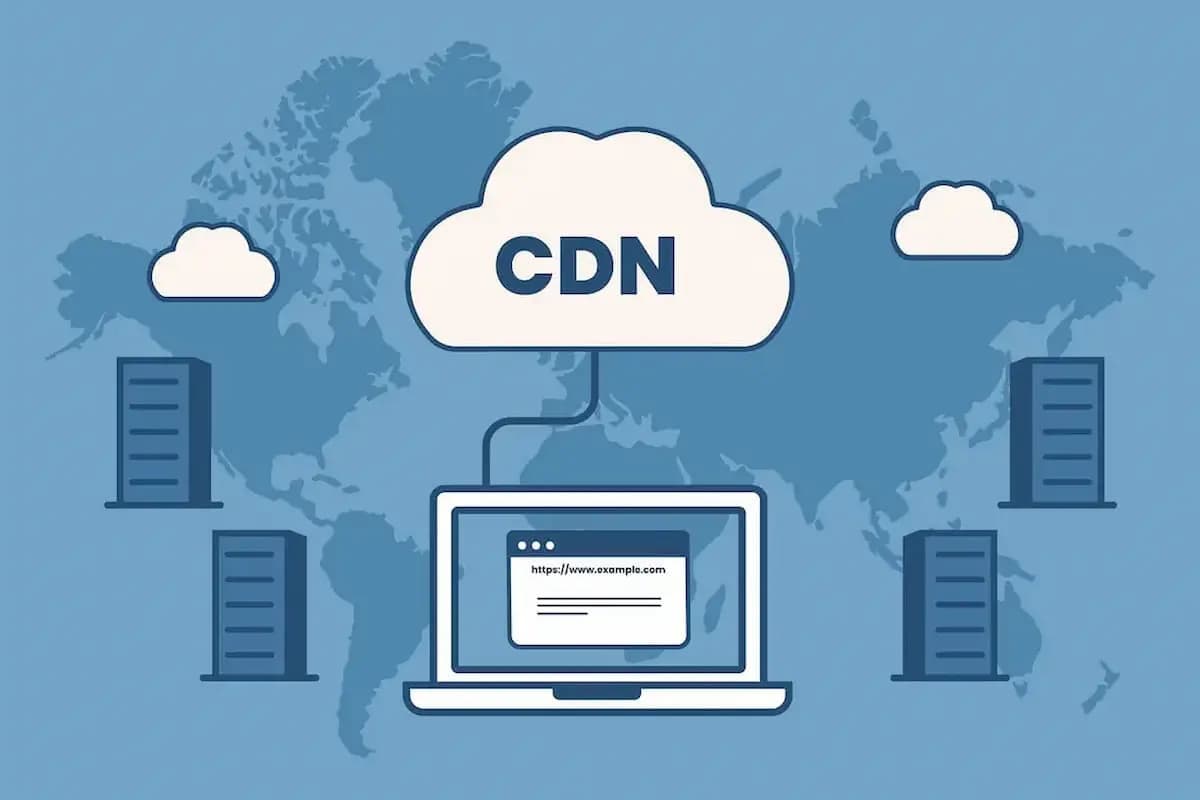
CDN, or Content Delivery Network, is a network of servers distributed across different geographic locations to deliver website content to users faster.
Every website has a main server, also known as a host server. If all users access content directly from this server, the website may take longer to load, especially when the files are large or the server is located far from the user.
This is where a CDN comes in. Website content is copied and stored on edge servers, which are CDN servers located closer to users. As a result, users can access website content faster and more reliably, creating a smoother browsing experience.
CDN Functions
Here are some key functions of CDN you should know:
1. Speed Up Content Delivery
In the past, global content delivery relied heavily on infrastructure such as satellites. However, this approach came with higher costs and greater latency, or the delay that occurs when data travels from a server to a user.
Today, content delivery can be optimized with a CDN, which stores content across multiple locations and reduces the distance between users and the server. If one server fails, another can take over, helping minimize downtime.
2. Reduce Bandwidth Costs
Besides speeding up content delivery, a CDN can also help reduce the bandwidth costs of the host server.
This is because not every user request needs to reach the host server. As a result, the server handles less traffic, which can also help reduce hosting costs.
3. Handle Multiple Users at Once
Every server has a limit on the number of users it can handle. When traffic exceeds that limit, the website may slow down or even go down.
A CDN helps reduce the load on the host server by distributing content across multiple edge servers. This allows a website to handle a large number of users at the same time without sacrificing speed.
4. Optimize Live Streaming
Live streaming comes with several challenges, including a large number of viewers, the need to minimize buffering, and high bandwidth requirements.
With a CDN, you can deliver live streams with minimal delay, even when many users are watching at the same time.
This is possible because a CDN efficiently distributes small video segments (chunks) through edge servers in different locations. It also optimizes the routes used to deliver data, helping ensure a smoother streaming experience.
Read also: 7 Effective Ways to Increase Website Speed
Components of CDN
Now that you understand the functions of a CDN, you may be wondering, “What are the main components or features of a CDN?”
In general, a CDN consists of several components that work together to deliver content quickly, reliably, and efficiently, including:
1. Domain Name System (DNS)
Domain Name System (DNS) is a system that translates human-readable domain names into Internet Protocol (IP) addresses that servers can understand.
In a CDN, DNS helps direct users to the most suitable server, usually the nearest edge server, by returning the appropriate IP address.
This process is known as dynamic routing, which selects the best server based on the user's geographic location and network conditions.
2. Point of Presence (PoP)
A Point of Presence (PoP) is a physical location where CDN servers are hosted. A PoP typically contains servers, routers, switches, firewalls, power supplies, and UPS (Uninterruptible Power Supply) systems.
In a CDN, PoPs store cached content in locations closer to users, allowing it to be delivered faster and more efficiently.
Websites such as e-commerce platforms and streaming services can benefit significantly from having more PoPs.
These websites are often accessed by users from different locations and can receive high volumes of traffic at the same time. With more PoPs, content is available from more locations, helping maintain stable performance across different regions.
3. Internet Exchange Point (IXP)
Another important CDN component is the Internet Exchange Point (IXP). It is a physical infrastructure that connects internet service providers with CDN networks.
With an IXP, data can be exchanged directly without having to travel through longer routes. This helps reduce latency and makes data delivery more efficient.
4. Application Delivery Controller (ADC)
A CDN also uses network devices designed to optimize application delivery. These devices are known as Application Delivery Controllers (ADCs) and can be implemented as either hardware or software.
In a CDN, ADCs are typically used in large-scale systems to improve response times and maintain stable performance.
Differences Between 2 Types of Content Delivered by a CDN
In practice, a CDN can deliver the following two types of content:
- Static content: Content that rarely changes or is the same for every user, so it does not need to be processed again by the server. Examples include a website logo, images, videos, JavaScript, and CSS.
- Dynamic content: Content that changes or depends on certain conditions and therefore needs to be processed by the server. Examples include the latest news, notifications, and product recommendations.
Read also: How to Create a Content Strategy for Optimal Business Growth
How Does a CDN Work?
A CDN works by establishing a network of edge servers across different geographic locations. This distributed network operates based on three main principles:
1. Caching
Caching is the process of storing copies of data so they can be accessed more quickly. In a CDN, caching means storing static content across multiple servers within the network. Here’s how caching works:
- When a user first accesses a website, the request is sent to the host server.
- The CDN stores a copy (cache) of the static content on the nearest edge server.
- When the same or another user requests the content again, the system can retrieve it from the nearest edge server instead of contacting the host server.
2. Dynamic Acceleration
While caching helps with static content, dynamic acceleration is used to speed up the delivery of dynamic content.
The CDN acts as an intermediary between the user and the host server. Even when data still needs to be retrieved from the host server, the CDN can help speed up the process by:
- Choosing the fastest available internet route.
- Using a server located closer to the host server.
- Compressing data to reduce its size.
3. Edge Logic Computing
A CDN does more than simply deliver data. It can also process requests directly on a server located close to the user. Some tasks that a CDN can handle at the edge include:
- Checking user requests and determining whether they are allowed.
- Blocking invalid or suspicious requests.
- Modifying or optimizing content before delivering it to the user.
That wraps up our explanation of what a CDN is, its functions, and how it works. As discussed above, improving website performance also requires optimization at the infrastructure level, and using a CDN is one way to achieve this.
By understanding what a CDN is, how it works, and how to use it effectively, you can improve system efficiency, user experience, and SEO performance.
Speaking of SEO, is your business already running a structured, measurable, and profitable SEO strategy?
If you’re still facing challenges with your business’s SEO efforts, SEO Services by cmlabs are ready to help with a data-driven and in-depth approach.
Our SEO services can also help you navigate CDN-related issues and optimize your CDN setup to further improve your business website’s performance. So, don’t hesitate to contact us, discuss your needs with our team, and get a special offer just for you!
Read also: Why is SEO for Website Important in Business Growth?

cmlabs Team
Thank you for taking the time to read my article! At cmlabs, we regularly publish new and insightful articles related to SEO almost every week. So, you'll always get the latest information on the topics you're interested in. If you really enjoy the content on cmlabs, you can subscribe to our email newsletter By subscribing, you'll receive updates directly in your inbox. And hey, if you're interested in becoming a writer at cmlabs, don't worry! You can find more information. here So, come join the cmlabs community and stay updated on the latest SEO developments with us!
Subscribe to Our Newsletter
Enter your email to receive news from us