
As an SEO Writer, I stay up-to-date with the latest SEO practices and industry insights to craft content that is search-optimized, credible, and genuinely valuable, designed to perform at its best on SERPs.
Collaborator

3 Website CTAs Compared: Which Works Best? Research Results Inside
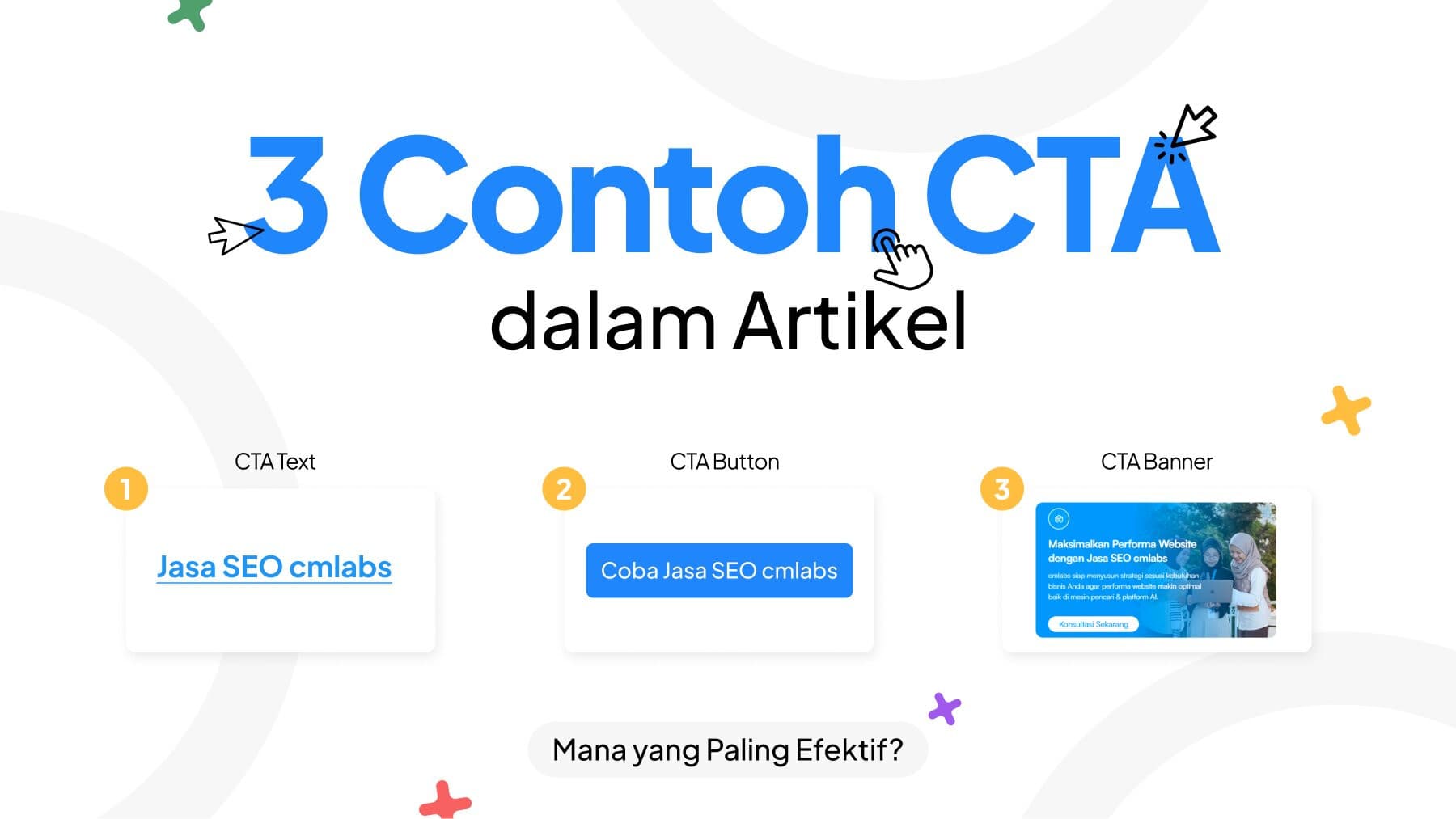
Call to action (CTA) is one of the key elements of a digital marketing strategy. Through a CTA, visitors are encouraged to take a specific action, such as reading another article, signing up for a service, or visiting a product page.
In practice, call to action examples in website articles can take several forms, such as anchor text inserted within a paragraph, a brightly coloured button, or a visual banner.
Since each format presents its message differently, visitors may respond differently to each one.
To find out which format is most effective at driving visitors to a service page, our team ran an A/B test on three types of CTAs in blog articles.
The test compared a text link, a CTA button (a brightly colored button), and a CTA banner (with added visual assets), with the goal of measuring the number of interactions each format generated.
Overall, the results show that the CTA button recorded the highest interaction rate. However, its performance was heavily influenced by a single article that contributed a dominant share of the clicks. Let’s take a closer look at the full explanation below.
Exploring Different Website Call to Action Examples
Before discussing the results of our internal test, it’s important to understand the three CTA formats used in this experiment. Each has different visual characteristics and placement.
1. Text Link
Text links are CTAs inserted as hyperlinks on words or sentences within the content. This format usually blends into the paragraph, so it doesn’t disrupt the reading flow much.
An example of a text link CTA is the phrase “Jasa SEO cmlabs” or “SEO Services by cmlabs,” which directs visitors to cmlabs’ SEO service page.
This format tends to look simple and is easy to implement. However, because it blends in with the surrounding text, visitors may not immediately realize that the link leads them to a specific action.
2. CTA Button
CTA buttons are interactive elements designed to be more easily recognized by visitors. They typically use a distinct color, size, and text to set them apart from other elements on the page.
One example of a CTA button we implemented is “Coba Jasa SEO cmlabs” or “Try SEO Services by cmlabs,” which directs visitors to cmlabs’ SEO service page.
Compared to text links, buttons look more prominent. Their placement can also be arranged so they’re easy to find after visitors have read the relevant information.
3. CTA Banner

CTA banners are visual call-to-action elements, usually a combination of text, an image, and a button. They can be placed between sections of an article or in specific areas of a website page.
An example of a CTA banner in a cmlabs blog article is a promotional visual for SEO services, complete with an image, a short description, and a “Try Now” button.
This format provides more space to deliver a promotional message. Visual elements can also attract visitors’ attention, although a banner’s effectiveness still depends on the relevance of the message and its placement.
Read also: Google AI Overview and Its Struggle to Keep Up with Human Wits
A/B Testing Methodology: How cmlabs Tested CTA Formats in Articles
We tested the three CTA formats (text links, buttons, and banners) to see how each affects visitor interaction. The test ran on cmlabs’ 20 top-performing blog articles from the month before the A/B test, with the goal of comparing the number of clicks across CTAs leading to the cmlabs SEO Services page.
We divided the experiment into three periods, with each test case running for 21 days. Each period used one CTA format so the results could be compared based on the data collected. The main metrics for evaluating CTA performance were sessions, click events, and interaction rate.
Here are the details:
- Number of test cases: Three (3): text link CTA, button CTA, and banner CTA.
- Research sample: 20 cmlabs blog articles on SEO topics.
- Research period: 3 periods of 21 days each.
- Evaluation metrics: Sessions, click events, and interaction rate.
Results & Findings: Three CTA Formats in cmlabs Articles
Once all the test periods were complete, we had data showing how each CTA format performed differently.
Metric | Text Link CTA | Button CTA | Banner CTA |
| Sessions* | 1,159 | 2,868 | 2,178 |
| CTA Click Events | 3 | 42 | 7 |
| Interaction Rate | 0.26% | 1.46% | 0.32% |
*sessions = total sessions across the 20 articles during the testing period.
Overall, the CTA button generated the highest number of clicks and the highest interaction rate. Meanwhile, text links recorded the lowest interaction, followed by CTA banners, which were only slightly higher.
Although the initial results point to the CTA button as the winner, the data from each period needs a closer look to understand what influenced its performance.
Text Link CTA Generates Limited Interaction
In the first test, we placed the CTA as a hyperlink within the article paragraph, as shown below.
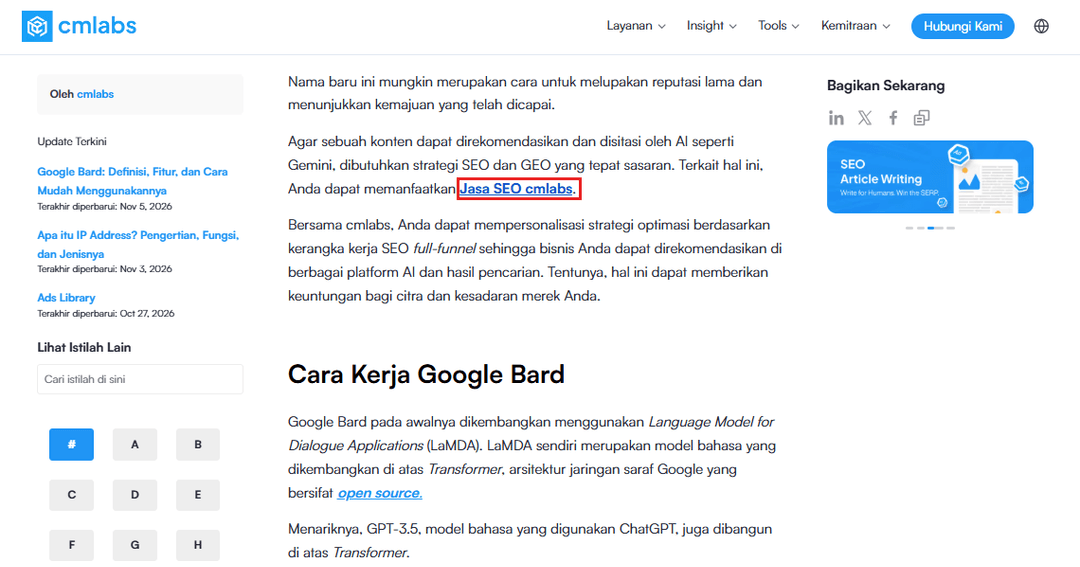
During the testing period, the 20 articles drew 1,159 sessions. Of these, 3 interactions were recorded (1 event on the /ai-search-google article and 2 events on the /google-bard article), for an interaction rate of 0.26%.
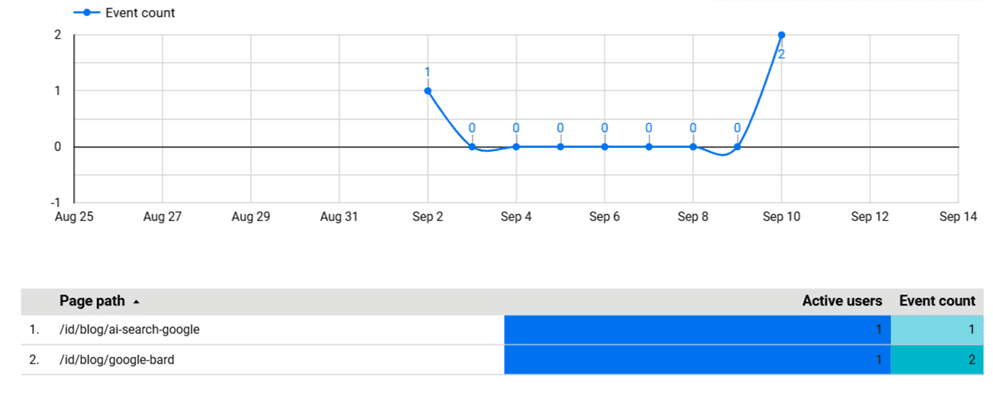
These results show that text link CTAs didn’t drive many clicks to the cmlabs SEO Services page. One factor that may have affected the result is its low visibility, which makes it easy for visitors to miss while reading the article.
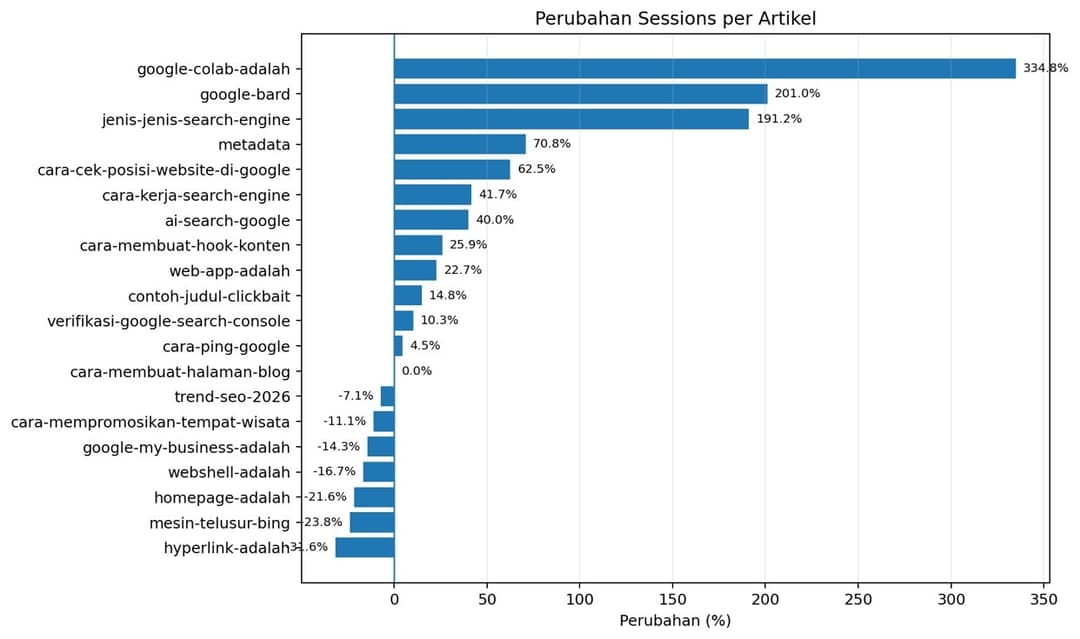
In terms of traffic, 12 articles showed an increase in sessions, 7 showed a decrease, and 1 showed no change. This means that differences in visits across articles were also taken into account when evaluating CTA performance.
Read also: A/B Testing Copywriting Strategies for Website Optimization
CTA Buttons Record the Highest Interaction
In the second test, we replaced the text link with a CTA button. The goal was to see whether a more prominent design could get more visitors to click.
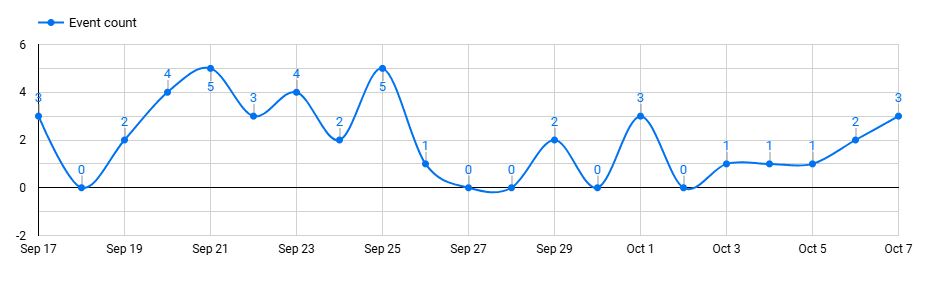
During the testing period, total sessions reached 2,868, with 42 interactions. The resulting interaction rate of 1.46% was the highest among the three CTA formats tested. The interactions were spread across 7 articles, and the two dates with the most interactions recorded 5 clicks each.
However, the clicks turned out to be concentrated in a single article, /google-bard. It generated 29 of the 42 total interactions, or about 69% of all CTA button clicks. The /cara-membuat-hook-konten article contributed 6 interactions, while the five other articles generated 1 to 2 interactions each.
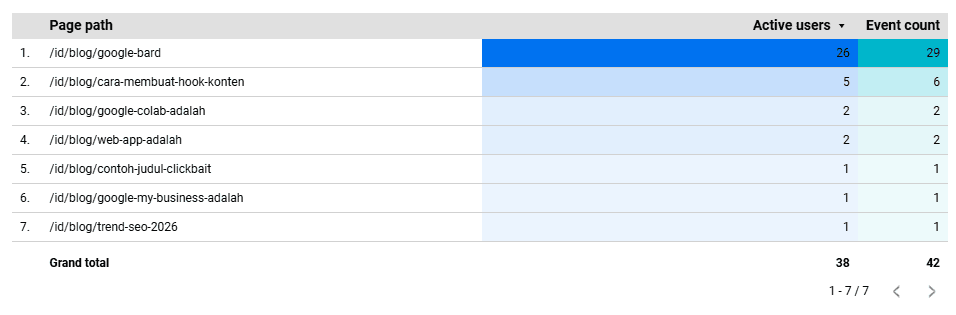
Interestingly, the /jenis-jenis-search-engine article, which had the highest traffic at 726 sessions, generated no CTA clicks at all.
This finding shows that high traffic isn’t always followed by CTA interaction. The relevance between an article’s topic and the offer shown may also influence whether visitors click the button.
We also ran an analysis excluding the /google-bard article to see whether the CTA button’s advantage still held when that article’s contribution wasn’t counted.
The result shows that the CTA button recorded 13 interactions from 2,394 sessions, an interaction rate of about 0.54%. This is higher than the text link CTA’s 0.26%, but the difference doesn’t yet show a statistically significant advantage.
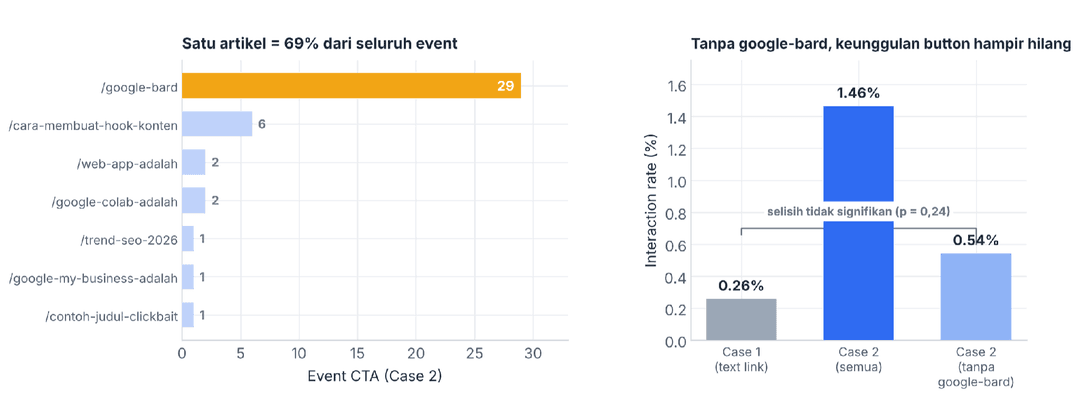
Based on the analysis above, it’s fair to say that the CTA button’s high overall interaction rate is still heavily influenced by a single article.
CTA Banners Haven’t Yet Shown a Significant Improvement
In the third test, we used a CTA banner as a more visually appealing way to invite visitors to the cmlabs SEO Services page. This element was expected to catch visitors’ attention through a combination of text and graphics.
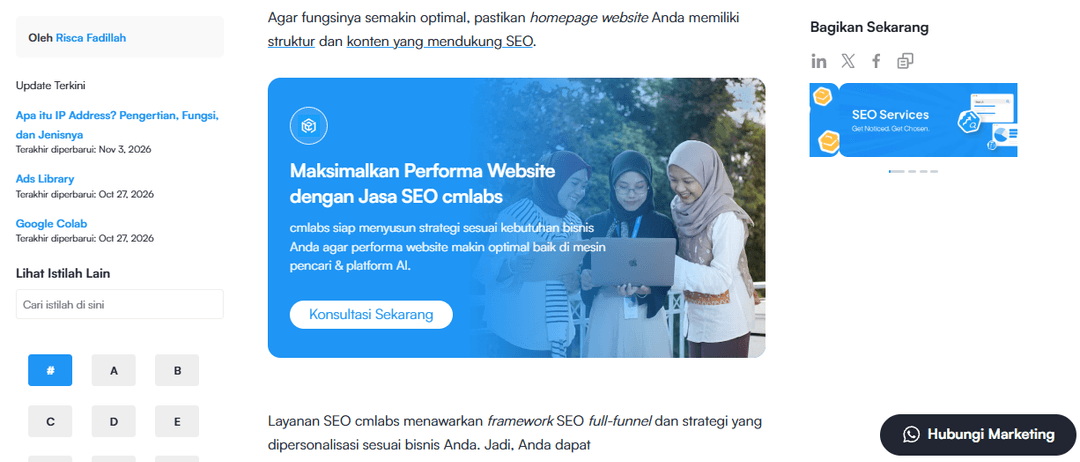
The 20 tested articles drew 2,178 sessions and generated 7 interactions, for a recorded interaction rate of 0.32%. Compared to the CTA button, the banner’s interaction count is much lower. However, its clicks appear to be more evenly spread across several articles.
On the other hand, only 6 of 16 observations recorded CTA interactions. In addition, 15 of the 20 articles saw a drop in sessions during the testing period.
At 0.32%, the banner’s interaction rate is also slightly higher than the text link at 0.26%. However, this gap isn’t enough to prove that the CTA banner performs better overall.
Read also: Google vs. GPT Search, Who Leads the Search Revolution?
Conclusion
Based on the analysis of the three CTA formats tested, the CTA button recorded the highest number of interactions and the highest interaction rate. This makes it the top candidate for further testing on articles.
However, the /google-bard article accounted for about 69% of all clicks, which shows that this result can’t yet be generalized to all articles. With that article excluded, the difference in interaction rate between the CTA button and the text link was not statistically significant.
The CTA banner also hasn’t shown a meaningful improvement over the text link. Further testing is therefore still needed to find out whether the format itself influences visitors’ decisions.
Going forward, tests could focus on how well the CTA fits the article’s topic or on element placement. With a data-driven approach, you can determine which CTA format is most relevant for getting visitors to your SEO services page.
If you want to improve your website’s visibility while reaching a relevant audience, you can use SEO Services by cmlabs. We offer a full-funnel SEO strategy personalized for your business, so you can get a better chance of being recommended by AI platforms.
Writing Services by cmlabs can also help you produce articles with the right CTAs to improve your CTR. So, don’t wait any longer and contact our marketing team now to discuss your website’s needs, both for technical and content production!

Risca Fadillah
Thank you for taking the time to read my article! At cmlabs, we regularly publish new and insightful articles related to SEO almost every week. So, you'll always get the latest information on the topics you're interested in. If you really enjoy the content on cmlabs, you can subscribe to our email newsletter By subscribing, you'll receive updates directly in your inbox. And hey, if you're interested in becoming a writer at cmlabs, don't worry! You can find more information. here So, come join the cmlabs community and stay updated on the latest SEO developments with us!
Subscribe to Our Newsletter
Enter your email to receive news from us