As an SEO Writer, I stay up-to-date with the latest SEO practices and industry insights to craft content that is search-optimized, credible, and genuinely valuable, designed to perform at its best on SERPs.
Collaborator

Perplexity AI: Technical & Content Optimization for Businesses

In the era of AI search, Perplexity AI helps users find the information they need faster. Interestingly, Perplexity also allows brands to increase their visibility on AI platforms by becoming a source cited in AI-generated answers. However, not every brand website is eligible to be selected as a source by Perplexity.
If you want your brand website to be cited, it is important to understand how the platform works, including its different modes, search process, and technical and content optimization strategies for businesses. Find the complete guide below!
What Is Perplexity AI?
Perplexity AI is an AI-powered answer engine that provides direct answers while citing sources that are relevant, reliable, and up-to-date. So, what does Perplexity do in practice?
Users often turn to Perplexity when researching and comparing different options. So, if your business wants to reach Perplexity users, you need the right strategy to increase the chances of your content being discovered and cited by the platform.
Perplexity AI Modes
Perplexity AI offers several modes, each designed to provide a different level of search depth. So, how should I use Perplexity? The answer depends on the depth of research you need. Understanding what each mode does can help you choose the right one for your needs and make the most of Perplexity for your business. Here are the details:
- Standard Search: A fast search mode designed to answer simple questions quickly.
- Pro Search: A more in-depth search mode that can perform multiple searches, reason across information from various sources, and allow eligible users to choose an AI model.
- Research: A research and reporting mode that performs dozens of searches, reviews hundreds of sources, and automatically selects the most suitable model for the task.
Read also: Good SEO Is Good AIO? Google's Danny Sullivan & John Mueller’s Perspective on SEO for AI
How Does Perplexity Find and Cite Information Sources?
So, how does Perplexity process a query and generate answers based on relevant sources? Here are the key steps you need to understand:
1. Understanding the User's Query
First, Perplexity uses its own internal Large Language Model (LLM), such as PPLX-online, to understand the context, meaning, and nuances of a user's query. This helps the system determine what information it needs to look for.
It's also worth noting that Perplexity Pro allows users to choose several AI models developed by other companies, such as OpenAI and Anthropic. However, its core search experience still relies on Perplexity's own models.
2. Searching the Web for Information
Once it understands the query, Perplexity searches for relevant information across various trusted sources, including websites, articles, and academic journals. These sources can be grouped into several categories based on their type and level of trustworthiness:
- Government: Official websites operated by government organizations, such as epa.gov and bps.go.id. These sources are useful for topics related to financial issues, legal questions, government services, and similar subjects.
- Academic: Scientific websites that provide information on topics such as medicine, mathematics, biology, physics, and related fields. Examples include science.org and garuda.kemdiktisaintek.go.id.
- Trusted: Broader sources that publish information within their areas of expertise and frequently appear in search results. Examples include nationalgeographic.com and siloamhospitals.com.
In addition to evaluating relevance and validity, Perplexity retrieves information in real time rather than relying solely on knowledge stored within its system. As a result, the information it provides can be more up-to-date.
3. Processing and Summarizing Information
Perplexity then verifies, processes, and synthesizes information from multiple sources into concise, coherent, and easy-to-understand answers. In other words, it does more than simply display a list of web pages like a traditional search engine.
Perplexity AI also promotes platform transparency by displaying the references used to generate its answers. This allows users to verify the information themselves or explore the sources for further details.
4. Continuing the Conversation
Perplexity's process does not end once it answers a single question. From the outset, the platform was designed as a conversational, context-aware answer engine. This allows users to continue the interaction through follow-up questions and two-way conversations.
For example, if a user asks about "tips for selling digital products" and Perplexity provides an answer, they can then ask for clarification on specific points they do not fully understand.
What Makes a Website a Source for Perplexity?
A website is more likely to be selected as a source by Perplexity if it meets several criteria, including:
1. Establish Domain and Brand Authority
Authority refers to a website's reputation and the content creator's expertise in a particular field. For example, academic journals have strong authority when it comes to academic research. However, being a well-known website does not automatically mean it will always be selected as a source.
If a large website covers a topic only broadly, while a smaller website provides more comprehensive coverage and demonstrates expertise in the relevant field, the smaller website can still have a chance of being cited by Perplexity.
2. Maintain a Well-Structured Website
A well-organized web structure includes clear headings and bullet points, concise and to-the-point explanations, and paragraphs that focus on a single idea.
These elements can make it easier for Perplexity AI to identify specific pieces of information that are relevant to a user's query.
3. Make Your Content Technically Accessible
To retrieve relevant information, Perplexity needs to access web pages and understand the information they contain. Therefore, you need to make sure there are no technical issues preventing crawlers from accessing your content.
How can you do this? Implement the technical SEO optimizations explained below!
Technical SEO Optimization for Perplexity
If you’re wondering how to optimize a website for Perplexity AI, start by implementing the following technical SEO optimizations to increase the chances of your content being cited by Perplexity:
1. Make Sure Your Technical Configuration Is Properly Set Up
Since Perplexity's systems need to access web pages to retrieve information, make sure there are no technical configurations that unintentionally prevent crawlers (bots that visit and read web pages) from accessing important content.
One technical configuration you should pay attention to is robots.txt. Check your Disallow rules and make sure important pages or directories are not blocked from being accessed by crawlers.
It is equally important to make sure your server is not experiencing issues that could prevent systems from crawling and indexing your web pages. A 5xx error indicates a problem with the server hosting your website. Therefore, check for pages experiencing errors and fix them as soon as possible.
2. Use a Clear HTML Structure
Using a clear HTML structure helps AI systems understand your website's content and identify key elements on a page, such as the title, navigation, and main content.
To achieve this, use semantic HTML elements according to their intended purposes, such as <header>, <nav>, <main>, <h1>, <h2>, and <footer>. These tags provide clearer context about the purpose of each section than generic elements such as <div> and <span>.
3. Use Schema Markup Properly
Schema markup is a type of code that helps AI systems and search engines identify entities, authors, dates, page types, specific facts, and other information.
Using the appropriate schema markup for your content type helps AI systems accurately understand what your content is about. Some commonly used types of schema markup include Article, Product, Organization, and Event.
4. Build a Clear Website Architecture
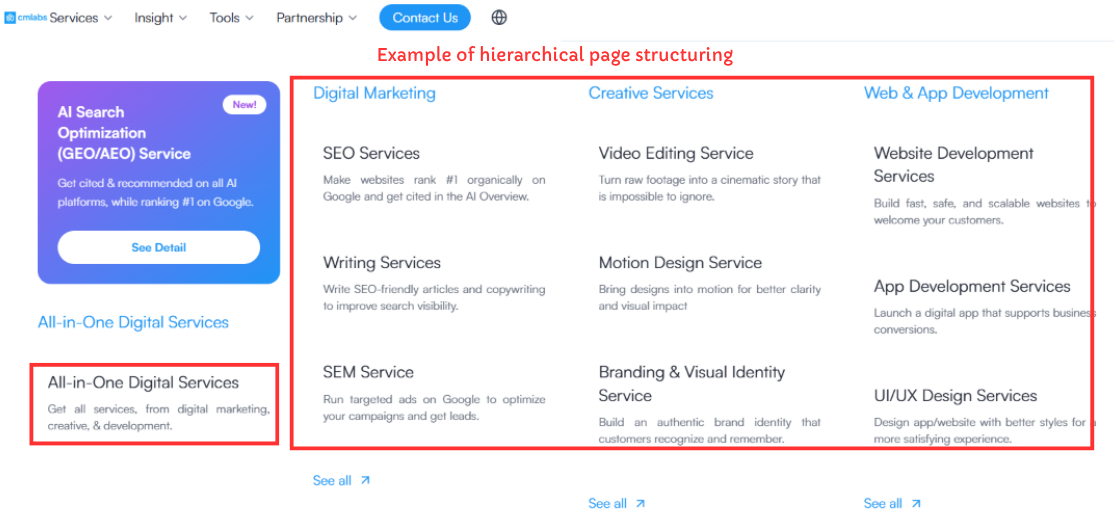
There are several ways to build a clear website architecture, including:
- Organize pages hierarchically: Structure your website from the homepage to categories, subcategories, and individual pages. Make sure every page can be reached within around three to four clicks from the homepage.
- Use internal linking: Connect relevant pages and help crawlers discover your content.
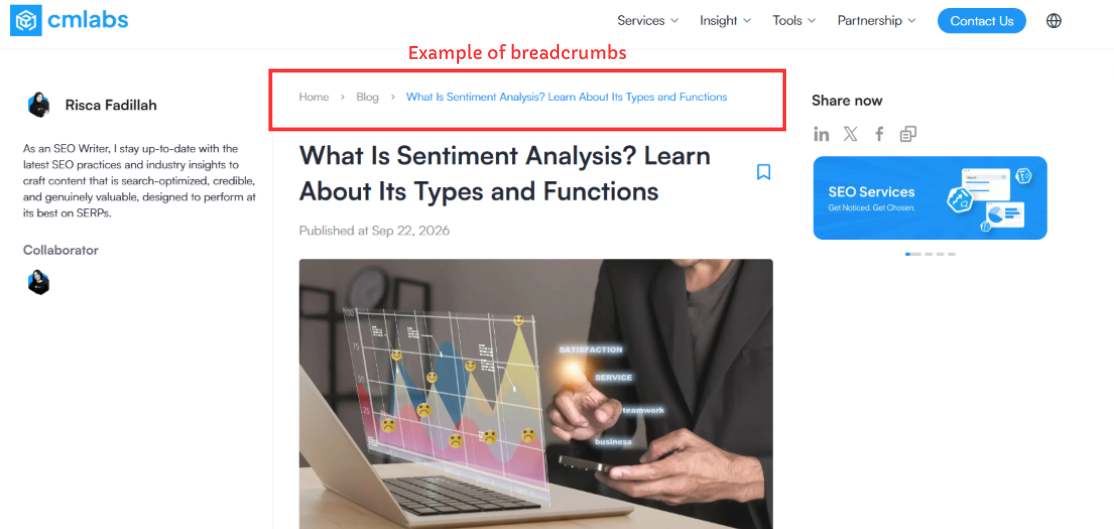
- Add breadcrumbs: Show where each page sits within your website's structure.
- Check for orphan pages: Orphan pages are pages that have no internal links pointing to them from other pages. To make them easier to discover, connect these pages to other relevant pages through internal linking.
Read also: The Ultimate Guide of Internal Link Strategy to Boost SEO
How to Optimize Content to Get Cited by Perplexity
Wondering how to get cited by Perplexity? In addition to technical SEO, don't forget to optimize your content using the following strategies:
1. Create Relevant and Up-to-Date Content
Relevance is one of the most important factors. Therefore, one way to optimize your website for Perplexity AI is to create content that matches the search intent and directly addresses the user's questions.
If your website is not yet well known, there's no need to worry. As long as your content provides a more relevant answer to the user's query, it may have a better chance of being cited than a more established website.
In addition to relevance, website owners should make sure their content stays up to date, especially for fast-changing topics such as AI, finance, and technology. Therefore, regularly updating your content is important to keep the information relevant and maintain its visibility.
2. Support Your Content with Accurate Evidence
The second content optimization strategy is to support your claims with strong evidence. Perplexity can compare information from multiple sources before generating an answer.
Content from credible sources that is backed by strong and consistent evidence is more likely to be used as a citation source. This evidence can include statistical data, research findings, expert opinions, and original sources.
3. Create Fact Blocks
Fact blocks are structured pieces of information that can be understood independently, such as tables, lists, or timelines. This format helps both readers and AI systems identify and understand key information more easily.
For Perplexity, fact blocks can make it easier to find and extract specific information when generating an answer. As a result, your content may be more likely to be used as a citation when it is relevant to the user's query.
4. Monitor and Audit AI Visibility
Finally, monitor your AI visibility to understand how your brand and content perform across various platforms, including Perplexity AI.
Pay attention to how often your brand is mentioned, cited as a source, and how its sentiment and share of voice change over time. This monitoring can help you identify ways to strengthen your brand presence on Perplexity while evaluating whether your content is sufficiently visible and relevant across AI platforms.
The good news is that cmlabs can help you conduct an AI visibility audit for your website. The FREE AI Visibility Audit by cmlabs takes just three business days, is 100% free, and comes with no contract.
Once you understand your website's performance and visibility across different AI platforms, you can move on to the optimization stage with AI Search Optimization (GEO/AEO) Services. This service helps businesses improve their visibility across targeted AI platforms, including Perplexity AI.
Don't worry! Our optimization strategies are tailored to how each target AI platform works. We understand that every AI system requires a different approach and a different way of grounding information.
We can also optimize your website from both internal and external perspectives. On the technical side, we make sure your website is accessible to and understandable by various AI crawlers. Externally, we help strengthen your website's authority through relevant media outlets and communities.
Want to learn more about optimization strategies to increase your business's chances of appearing in AI-generated answers? Don’t wait any longer and contact our team today!
Read also: Google Gemini AI: Features & Best Practices for Business

Risca Fadillah
Thank you for taking the time to read my article! At cmlabs, we regularly publish new and insightful articles related to SEO almost every week. So, you'll always get the latest information on the topics you're interested in. If you really enjoy the content on cmlabs, you can subscribe to our email newsletter By subscribing, you'll receive updates directly in your inbox. And hey, if you're interested in becoming a writer at cmlabs, don't worry! You can find more information. here So, come join the cmlabs community and stay updated on the latest SEO developments with us!
Subscribe to Our Newsletter
Enter your email to receive news from us