The Fact about Meta Description and Its Impact on Ranking

The character length of a meta description is often associated with ranking in search engines. However, in reality, the length of the meta description is not directly related to ranking. So, what is the role of a meta description in SEO? Here's the discussion
Meta description is an on-page element optimized to a specific length. However, does it affect ranking? The fact is that the length of the meta description does not influence ranking but is essential for user experience. Here's the explanation.
Key Takeaways
- John Mueller, a representative from Google, responded to a tweet about the length of meta descriptions and their impact on ranking.
- Mueller stated that the influence of meta-description length on ranking is nothing but a misconception.
- Nevertheless, the length of meta descriptions remains highly important in content writing.
John Mueller, a representative from Google, has challenged the long-standing belief that the length of a meta description directly influences Google search rankings. Through his account X, he stated:

Context of the Discussion
Initially, a user with the username Khushal Bherwani asked John Mueller about the length of meta descriptions based on his experience dealing with client websites.
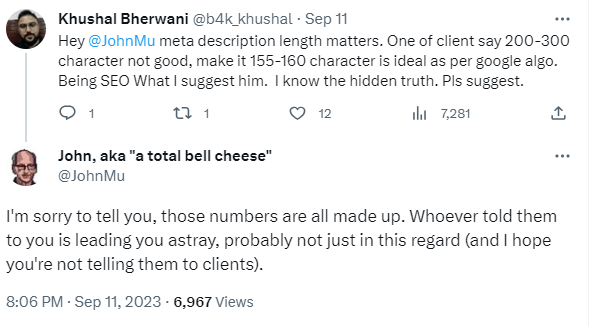
In his question, Khushal shared an experience in which a client insisted that the length of the meta description could affect search rankings. The client proposed that the length of this element should be around 155-160 characters, citing "the Google algorithm" as the source of this information.
In response, Khushal sought clarification from John Mueller. In a brief response, Mueller refuted the idea that the meta description's length should be around 155-160 characters as determined by the Google algorithm, stating, "not true."
The Role of Meta Description
Meta descriptions serve as a brief summary of the content of a web page and often form a user's first impression of a website's content. This description not only influences users' decisions to click on links but also plays a role in SEO by providing context to search engines and users about the page's content.
Over the years, many have assumed that Google's search ranking algorithm favored short and information-rich meta descriptions.
However, in the context of ranking, it is clear that the character count is not a ranking factor taken into account. Instead, it is very useful when implemented with the goal of providing a good user experience in reading the page's content.
A Content Writer's Perspective on Meta Description Length
The primary purpose of a meta description for an article is to provide a summary to users and search engines so they can understand the article's content at a glance.
In general, content writers will craft meta descriptions with a maximum length of 150-160 characters. This is to ensure that the text is not truncated when it appears in search results. While Google typically selects the meta description to display, the ideal length remains important.
With a character limit, users can read the entire meta description. Therefore, it should be concise, clear, and able to describe the content within a maximum of 150-160 characters.
Based on this and regardless of the statement that meta description length does not affect ranking, it is still guided by the original purpose, which is for the user.
In conclusion, the focus in writing a meta description should not solely be on ranking but on providing a better user experience, which is clear, precise, and not truncated.
Article Source
As a dedicated news provider, we are committed to accuracy and reliability. We go the extra mile by attaching credible sources to support the data and information we present.
Twitter Discussion Forum: https://twitter.com/JohnMu/status/1701220595289981212
For more information about cmlabs and our services, please contact us at:
E-mail :
marketing@cmlabs.coPhone : (0341) 475665
cmlabs
Another post from cmlabs


More from cmlabs News -your daily dose of SEO knowledge booster
cmlabs x LPTUI Collaborated to Deliver an Online Psychotest Platform for a Government Program
cmlabs Won Bronze Medal & Top Outstanding Project at the Prestigious BRICS Industrial Innovation Contest 2025
cmlabs won a Bronze Medal & Top Outstanding Project at the BRICS Industrial Innovation Contest 2025 with Orion, an AI for data-driven marketing.
cmlabs Becomes Guest Speaker at BRI Group Meeting, Highlights the Importance of SEO for PR Corporate Branding
cmlabs participated as a Guest Speaker at the BRI Group meeting, discussing the importance of SEO in supporting PR and corporate branding.