As an SEO Writer, I stay up-to-date with the latest SEO practices and industry insights to craft content that is search-optimized, credible, and genuinely valuable, designed to perform at its best on SERPs.
Collaborator

How to Check SEO Score & Tools That Can Be Used, Take Note!

Now, more and more brands are utilizing websites to expand their reach to target markets. So, it's no wonder that the competition in search results is getting tighter.
To achieve a high ranking, websites are required not only to display quality content but also to have optimal technical performance.
Therefore, checking the SEO score becomes a crucial step to measure the readiness of a website to face this competition. But, actually, how can you check the SEO score efficiently? Find the complete guide in the following explanation!
What Is an SEO Score?
An SEO score is an indicator that shows how well the technical aspects and content of a website support SEO effectiveness and increase the chances of achieving high rankings on search engines.
SEO scores are generally classified into several value ranges. Although each tool may have varying assessment standards, in general, a website's SEO score is divided into the following categories:
- Excellent (91–100): The website is highly optimized, making it easier to compete on search engines.
- Good (71–90): The website is quite good, but there are still minor issues, such as broken links or meta descriptions that are not fully optimized.
- Average (51–70): SEO optimization is still standard and not yet maximized.
- Poor (0–50): The website needs significant SEO improvements.
The Importance of Checking SEO Score
The SEO score can be considered an indicator of a website's health. Therefore, checking it becomes a very important step for the following reasons:
- Serving as a benchmark for website visibility on search engines: By checking the SEO score, you can know the level of visibility of the website on the SERP. If the results are less than optimal, you can carry out various optimizations to increase organic traffic as well as user engagement.
- Closely related to user experience: Websites with a high SEO quality score generally can load quickly, are easily accessible from mobile devices, and display quality content. This affects the user's comfort in browsing the website, thereby potentially increasing the conversion rate and brand loyalty.
- Supporting business growth: In the long term, increased traffic, brand loyalty, leads, and conversions can help the business grow significantly.
Read also: 5 Ways to Increase Website Traffic and Boost Profits
Factors Affecting SEO Score
In practice, the SEO quality score can be influenced by various factors, including:
1. Meta Title and Meta Description
The meta title is the page title that appears in the SERP as well as in the browser tab. Meanwhile, the meta description is a brief description that appears under the title in the SERP.
Although neither directly affects ranking, search engines still pay attention to the use of keywords and character length in the meta title and meta description.
This is because both factors significantly affect Click-Through Rate (CTR), organic traffic, and user interest in clicking the related content.
However, inserting keywords must be done naturally and not in a spammy way. For example, if you use the keyword “laptop service,” avoid creating a meta title like “Laptop Service Palembang | Cheap Laptop Service | Fast Laptop Service.” A natural meta title example would be “Laptop Service in Palembang and Its Complete Address.”
2. Content Quality
Content is like a “bridge” between a website and its audience. Therefore, you must provide content that is original, useful, and adds value for them.
Search engines also favor content that addresses the audience's search intent. For example, if the audience is looking for information about “how to take care of a laptop,” search engines will prefer articles that explain concrete steps, provide complete technical solutions, and are easy to understand.
Furthermore, the depth of content can also affect a website's SEO quality score. If it is too shallow, the audience may still be confused, and search engines may consider the related content to be of low quality.
3. Link Building
Link building refers to the effort to obtain backlinks from other websites. This factor also affects the SEO score because it serves as a signal that a website is considered trustworthy and relevant by search engines.
The higher the quality of the backlinks acquired, the better their impact on the SEO score. Backlinks considered high-quality generally come from trusted websites, have high authority, and are relevant to the related business niche.
Examples of high-quality backlinks are when your content is recommended by bloggers in the same niche or when you obtain backlinks from trusted business partners.
4. Heading Structure
Headings are elements within a website used to organize and divide content so that it is more structured. The hierarchy starts from H1 as the main page title, H2 as the main subheading, H3 as an explanation of H2, and so on.
Headings help the audience follow the flow of the article systematically while also making it easier for search engines to understand the page's topic better. This certainly has a positive impact on SEO score because it helps improve readability and user experience.
5. Website Speed
In fact, website speed (page speed) not only affects user experience but also SEO evaluation.
This is because a website that loads quickly makes it easier for search engines to access, read, and index web pages. This, in turn, helps search engines understand the website more optimally and supports better ranking opportunities.
On the contrary, slow websites are at risk of increasing the bounce rate, which is the condition when users leave immediately without further interaction. A high bounce rate indicates poor website performance.
6. Mobile Friendliness
Nowadays, more and more internet users access websites using mobile devices, such as smartphones or tablets. Therefore, search engines assess and index websites based on the mobile version first.
This highlights the importance of creating a mobile-friendly website because it will affect the SEO score.
Some characteristics of a mobile-friendly website include a display that can adjust to screen size, buttons that are easy to click, text that is easy to read, and navigation that is easy to use.
7. Website Security
One of the factors that affects website security is the use of HTTPS. HTTPS functions to encrypt data sent between the website and the user, making the information more protected. An indication that a website is using HTTPS is the presence of a padlock icon in the browser.
Search engines themselves consider the use of HTTPS as one of the assessment factors in determining website ranking. On the other hand, HTTPS can also help increase CTR because audiences tend to be more confident in accessing websites that appear secure in the SERP.
8. Image Optimization
Image optimization helps search engines understand the context of the page, the content of the images, and the relevance of the content.
Therefore, well-optimized images have a higher chance of appearing in Google Images, driving traffic to the website, and subsequently having a significant impact on SEO score.
Among the ways that can be done to optimize images are creating clear file names and alt tags, compressing images, and paying attention to copyright.
Read also: Image SEO: A Complete Guideline for Optimized Images
How to Check SEO Score & Its Tools
Here are some ways to check SEO score, along with recommended tools that can be used:
1. Website Health Checker by cmlabs
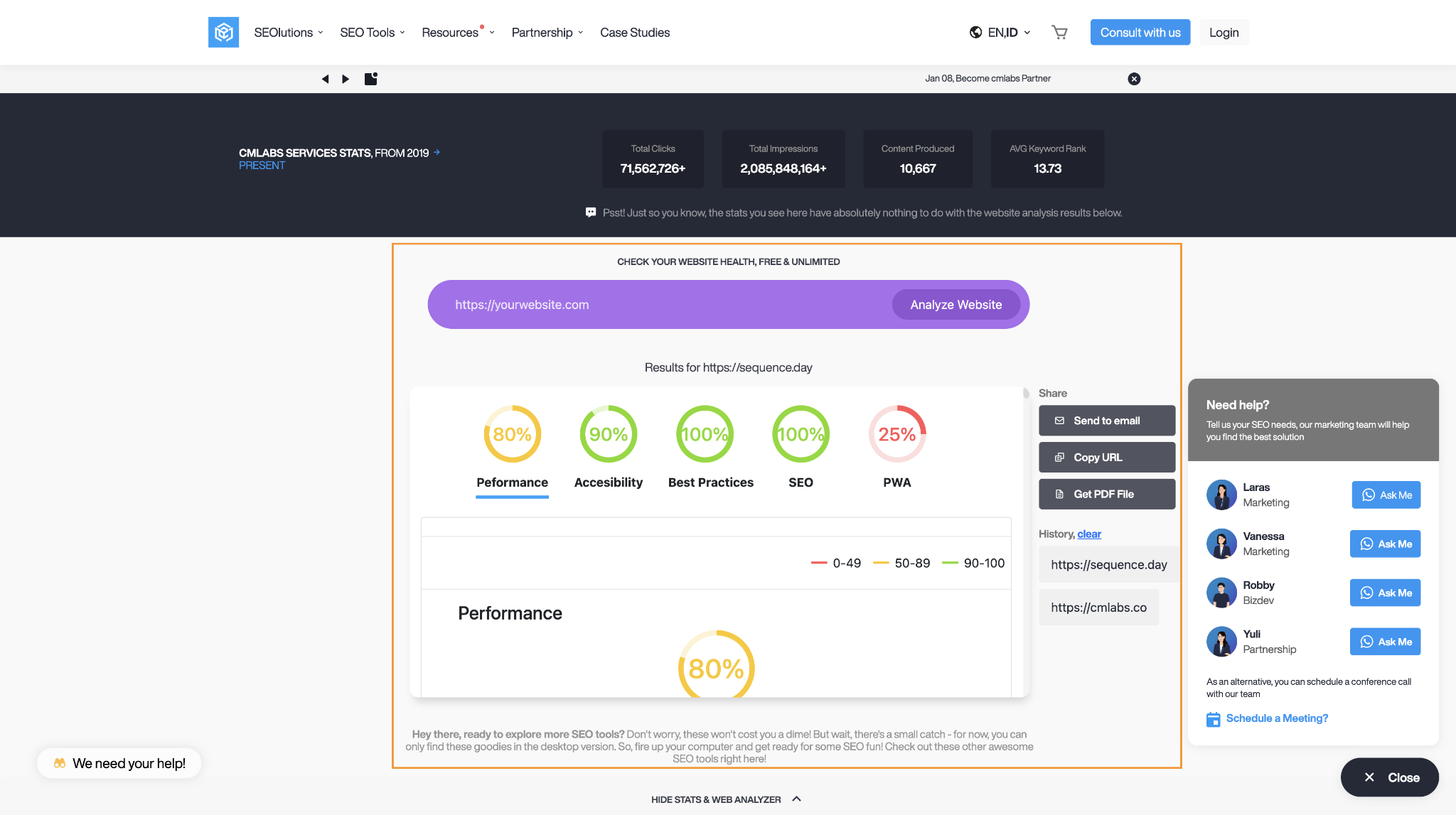
The first recommended tool is Website Health Checker by cmlabs. This tool helps you analyze the performance and health of your website comprehensively with just one click, making it easier and faster. Interested in trying it? Follow this guide:
- Open the cmlabs.co website.
- In the dialog box, like the image below, enter your website URL

- The system will perform checks automatically.
- Use the analysis results to identify technical issues as well as SEO aspects that need to be optimized.
2. SEMrush
Next, you can also measure the SEO score using a tool from SEMrush called Site Audit. Below is the step-by-step guide:
- Log in to SEMrush, then select SEO in the left sidebar and click Site Audit.
- Enter the website URL you want to analyze, then click the Start SEO Audit button.
- Set up the audit configuration, such as the number of pages to be checked, crawl source, and project name.
- SEMrush will scan various technical and on-page SEO factors, such as meta tags, JavaScript, and broken links.
- Review the SEO audit results by paying attention to the details of the issues and the priority level of their resolution.
- Fix SEO issues by following the recommendations and guidelines from SEMrush.
- Run the audit again and perform regular monitoring.
3. Ahrefs
The latest way to check the SEO score is by using the Site Audit from Ahrefs with the following steps:
- Create an Ahrefs Webmaster Tools account.
- Log in to the dashboard, select Create, then click Project.
- Import the website from Google Search Console or add it manually.
- Set up the audit settings, including schedule, number of pages to be checked, and crawl settings according to the website's needs.
- Ahrefs will start scanning all pages of the website, look for technical SEO issues, and display the Health Score (SEO score) as a percentage.
- Study the SEO issues found, then fix them according to priority.
- Perform regular audits.
Here is a guide on how to check your SEO score, complete with tools that you can use. It should be noted that each tool has different assessment parameters. This automatically requires a deep understanding of the context of each metric.
If you still encounter many difficulties in understanding this context, there is nothing wrong with seeking help from experienced partners like cmlabs.
SEO Services by cmlabs are ready to help you navigate the effectiveness of your website’s SEO strategy more comprehensively. Furthermore, this service also provides relevant and actionable improvement solutions.
Want to get complete information about this service? Contact our marketing team now and discuss your SEO needs!
Read also: 8 SEO Trends in 2026 & Strategies to Keep Your Brand Relevant

Risca Fadillah
Thank you for taking the time to read my article! At cmlabs, we regularly publish new and insightful articles related to SEO almost every week. So, you'll always get the latest information on the topics you're interested in. If you really enjoy the content on cmlabs, you can subscribe to our email newsletter By subscribing, you'll receive updates directly in your inbox. And hey, if you're interested in becoming a writer at cmlabs, don't worry! You can find more information. here So, come join the cmlabs community and stay updated on the latest SEO developments with us!
Subscribe to Our Newsletter
Enter your email to receive news from us